Most people who encounter Bushido do so through movies, anime, or a single paragraph in a history book. They learn that it was a warrior's code. They nod. They move on.
That's a shame — because Bushido is one of the most practically useful ethical systems ever developed. Not because it teaches you to fight, but because it teaches you to choose: how to act when integrity is costly, how to stay composed when emotions run high, how to build the kind of character that holds under pressure.
This guide breaks down the seven core virtues of Bushido and shows you how to apply each one to modern life — not as inspiration, but as a framework you can actually use.
"The way of the warrior is not about how you fight. It's about how you live when no one is watching."
What is Bushido?
Bushido (武士道) translates literally as "the way of the warrior." It emerged in feudal Japan as the moral code of the samurai class — a set of principles governing conduct not just on the battlefield, but in daily life: how to treat others, how to speak, how to make decisions, and how to face hardship.
The code was popularized in the West by Inazo Nitobe's 1900 book Bushido: The Soul of Japan, which drew parallels between the samurai's ethics and European chivalry. But unlike chivalry — which faded into romance — Bushido has remained a living philosophy, still influencing Japanese business culture, martial arts, and personal ethics today.
At its core, Bushido rests on seven virtues. Each one is demanding. Together, they form a coherent system for building character.
The seven virtues — and how to live them now
Virtue 1 · 義
Gi — Righteousness (Rectitude)
Gi is the foundation. It means doing what is right — not what is convenient, profitable, or popular. For the samurai, Gi was the moral compass that governed every decision. For you, it means acting with fairness and consistency, especially when the cost is real. In practice: the next time you face a decision where the honest path is the harder path, notice the pull toward convenience. That moment of noticing is where Gi begins.
Virtue 2 · 勇
Yu — Courage
Bushido does not ask you to be fearless. It asks you to act despite fear. Yu is the courage to speak an uncomfortable truth, to make an unpopular decision, to stand by your values when it costs you something. The samurai understood that courage without righteousness is recklessness. Gi gives you the compass; Yu gives you the will to follow it.
Virtue 3 · 仁
Jin — Benevolence (Compassion)
Perhaps the most underestimated virtue. The most powerful samurai were also the most compassionate — not because they were soft, but because they had nothing to prove. Jin means treating others with genuine care: colleagues, subordinates, even opponents. In a culture that rewards aggression and detachment, benevolence is a radical act.
Virtue 4 · 礼
Rei — Respect
Rei is more than politeness. It's a recognition of the inherent worth of others — including people you disagree with, or who have less power or status than you. For the samurai, a warrior who showed disrespect revealed a weak character. In modern life: Rei shows up in how you listen, how you communicate, and how you treat people when you don't need anything from them.
Virtue 5 · 誠
Makoto — Honesty (Sincerity)
Samurai did not sign contracts — their word was the contract. Makoto demands complete sincerity: in what you say, in what you commit to, and in how you represent yourself. In modern life, where half-truths are currency and selective honesty is normalized, Makoto is a differentiator. People who embody it become rare and trusted.
Virtue 6 · 名誉
Meiyo — Honor
Honor in Bushido is not about reputation — it's about the gap between who you claim to be and who you actually are. A samurai with honor lives the same whether watched or alone. Meiyo is the internal standard you hold yourself to, independent of external recognition. It's what makes integrity consistent, not situational.
Virtue 7 · 忠義
Chugi — Loyalty
Loyalty in Bushido is not blind obedience. It's a deep commitment to what — and who — you have chosen to stand for. For the samurai, this meant unwavering devotion to their lord. For you, it means showing up fully for the people and causes you've committed to, especially when it requires sacrifice. Real loyalty is tested by difficulty, not expressed in calm.
How to start applying Bushido today
Reading about virtues is easy. Living them requires a system. Here's a simple starting framework:
- 1Pick one virtue per week. Don't try to overhaul your entire character at once. Choose one virtue and look for two or three concrete situations in your week where it applies.
- 2Name the moment. When you face a choice that tests your integrity, courage, or respect — name it. "This is a Gi moment." Naming it gives you half a second of clarity before you react.
- 3End-of-day audit. Each evening, ask: Did I act with the virtue I chose this week? If not, why? What would I do differently? Don't self-punish — self-examine.
- 4Look for friction points. The virtues you find hardest to practice reveal the most about your character. Lean into friction — that's where real development happens.
Go deeper
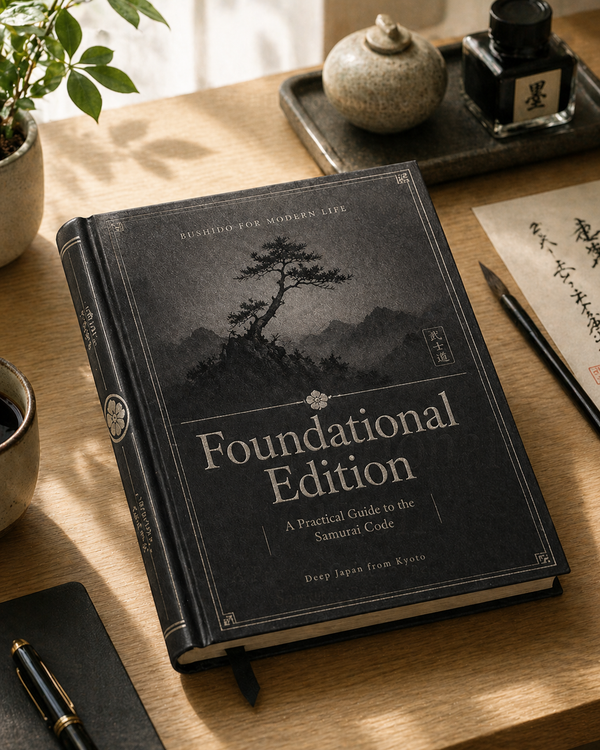
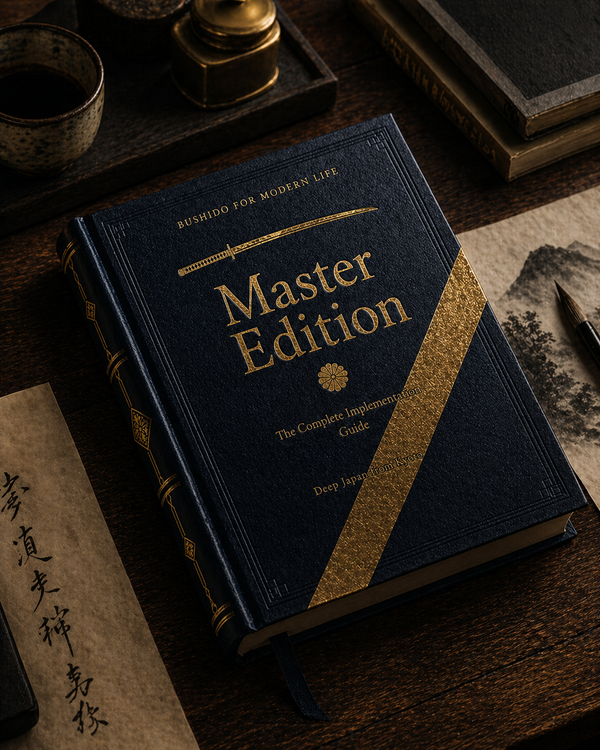
Bushido for Modern Life — Starter Edition
A practical introduction to Bushido as a modern ethical framework. Learn the core virtues, how they apply to business, relationships, and decision-making — and how to begin living them right now.
Instant digital download · English
Why Bushido still matters
We live in an environment optimized for the opposite of Bushido. Attention is fragmented. Honesty is strategized. Loyalty is conditional. Self-control is undermined at every turn by systems designed to exploit impulsivity.
This is precisely why Bushido is relevant — not as nostalgia, but as resistance. It offers a coherent counter-framework: a set of principles that hold under pressure, that reward long-term character over short-term gain, and that treat integrity as non-negotiable rather than situational.
You don't need to be Japanese, study martial arts, or adopt any cultural identity to benefit from this framework. Bushido is a system for making decisions and building character. Like Stoicism, like Chivalry, it translates — because the problems it addresses are human, not historical.
"The virtues of Bushido are all focused on how one thinks, not physical strength. That's where our daily battles are fought."
Frequently asked questions
What are the 7 virtues of Bushido?
The seven core virtues are: Gi (righteousness), Yu (courage), Jin (benevolence), Rei (respect), Makoto (honesty), Meiyo (honor), and Chugi (loyalty). Some versions include an eighth virtue: Jisei (self-control).
Is Bushido still relevant today?
Yes. While the samurai class no longer exists, the principles of Bushido remain deeply practical — particularly for anyone focused on integrity, leadership, and character development in modern life.
How is Bushido different from Stoicism?
Both emphasize self-control, virtue, and resilience. Stoicism focuses primarily on the individual's inner relationship with events. Bushido places equal weight on relational virtues — loyalty, respect, and compassion for others — making it more explicitly social in orientation.
Can non-Japanese people practice Bushido?
Absolutely. Bushido is an ethical framework, not a cultural identity. Its virtues — courage, honesty, respect, integrity — are universal, and have been applied by people across cultures for over a century.
Want to go beyond the basics? The Bushido for Modern Life — Starter Edition is a practical eBook that walks you through each virtue with real-world applications, comparisons to Western ethics, and tools you can use immediately.