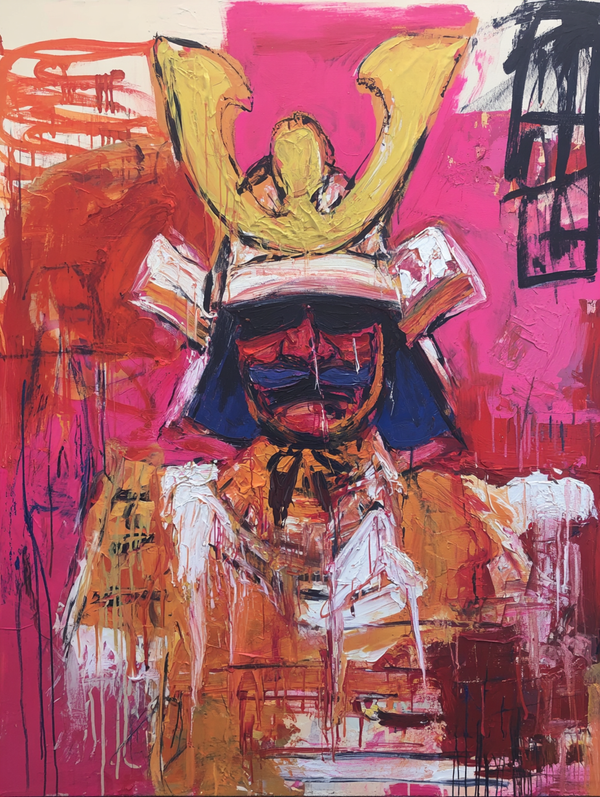
Why a 400-Year-Old Story Feels Like Breaking News
Something unusual happened when SHOGUN aired on FX in 2024.
A period drama set in feudal Japan — subtitled, historically specific, and centered on a culture most American viewers had never studied — became one of the most-watched and most-discussed television events of the year. It won eighteen Emmy Awards. It was renewed before the season finished airing.
The question worth asking is not whether SHOGUN is good television. It clearly is. The question is: why does it feel so urgent, right now, to so many people who have no particular connection to 17th-century Japan?
The answer, when you look at it carefully, has less to do with Japan than it does with America — and with what happens to any society when the structures that hold it together begin to fail.
The World Inside SHOGUN
SHOGUN is set at one of the most volatile moments in Japanese history: the period immediately following the death of the great unifier Toyotomi Hideyoshi in 1598, before Tokugawa Ieyasu had consolidated his hold on power at the Battle of Sekigahara in 1600.
Japan in this moment was a country with a formal structure and no functioning center. The Council of Regents — five powerful lords nominally governing on behalf of Hideyoshi's young heir — was fracturing along personal, political, and regional lines. Every faction claimed to represent legitimate authority. Every faction was, to some degree, pursuing its own survival and advantage under that cover. The question of who actually governed Japan — who had the right to make binding decisions, who could be trusted to honor agreements, whose word meant something — was genuinely open.
Into this environment comes Toranaga — the character at the center of the drama, based loosely on Tokugawa Ieyasu himself. Toranaga is not the most powerful man in Japan when the story begins. He is, in many ways, cornered. What distinguishes him is not his military strength but his judgment: his ability to see the actual structure of a situation through its noise, to make decisions that hold up over time, and to maintain a personal standard that others — even enemies — come to recognize as reliable.
He is, in the language of Bushido, a man of Gi(義).
Why This Story Resonates in America Right Now
The United States in the mid-2020s is not feudal Japan. The differences are obvious and important. But the structural parallel that makes SHOGUN feel urgent to American viewers is not about samurai or swords. It is about the experience of living in a society where the shared assumptions that make collective life function are visibly weakening.
Americans watching SHOGUN are living through a period of accelerating institutional distrust. The credibility of elections, courts, media, scientific consensus, and political leadership has been contested, from multiple directions, with increasing intensity. The result is not the absence of authority — authorities still exist and still make decisions — but the erosion of legitimacy: the widespread feeling that the rules are not being applied consistently, that the people in power are pursuing private interests behind the language of public ones, that the agreements that hold a society together are being honored in form while being abandoned in substance.
This is precisely the environment SHOGUN depicts. The Council of Regents in the drama is not a corrupt institution in the simple sense. Most of its members believe, to some degree, in the legitimacy of what they represent. But they are operating in a system where the underlying trust that makes institutions function has already begun to erode — and where each actor's response to that erosion makes it worse. The spiral is recognizable to anyone watching American politics in 2024.
What the American viewer finds in Toranaga — and what they are not finding in their own political environment — is the specific combination of competence and integrity that genuine leadership requires. Not perfection. Toranaga is not a perfect man. He is calculating, sometimes ruthless, willing to accept significant human cost in pursuit of a goal he believes is legitimate. But he is consistent. His word, once given, holds. His standard, once established, does not shift with the political weather. He does not say one thing and do another.
In the language of Bushido: he maintains Makoto(誠)— the alignment between words and actions — even when maintaining it is costly. And in an environment where that quality has become rare, its presence is striking enough to anchor an entire drama.
The Historical Context: What 17th-Century Japan Actually Resolved
Understanding why SHOGUN resonates requires understanding what actually happened in Japan after the moment the drama depicts.
The Battle of Sekigahara in 1600 was decisive. Tokugawa Ieyasu defeated the coalition opposing him and began the consolidation that would produce the Edo period — approximately 260 years of relative domestic peace, from 1603 to 1868. This is remarkable by any historical standard. Centuries of what the Japanese called the Sengoku period — the age of warring states, in which social order was genuinely in question — gave way to a period of stability long enough to produce entirely new forms of culture, commerce, and social organization.
The Edo period was not a paradise. The stability came with significant constraints: a rigid class system, the policy of national isolation (sakoku) completed in the 1630s, and forms of social control that modern sensibilities would find oppressive. But the question of whether Japan would have a functioning social order — whether agreements would be honored, whether institutions would hold, whether tomorrow would resemble today in its basic structure — was answered. The cost of answering it had been enormous. The benefits, measured across generations, were also enormous.
The historical lesson that SHOGUN implicitly offers is this: social order is not self-maintaining. It requires people — many people, across many levels of society — who hold internal standards that function even when external enforcement is absent or unreliable. The Edo period did not sustain itself on military force alone. It sustained itself, in part, on a widely shared ethical framework that governed how people with power were expected to use it.
That framework was Bushido.
What Bushido Actually Has to Do With It
Bushido is often misunderstood as a warrior's code — a set of rules for combat and personal honor with limited application outside the specific context of samurai culture. This misunderstanding misses its most important feature.
Bushido emerged from the experience of the Sengoku period in the same way that SHOGUN's drama emerges from it: as a response to the question of what holds a society together when its formal structures are failing. The virtues it articulates — Gi(義), Yu(勇), Jin(仁), Rei(礼), Makoto(誠), Meiyo(名誉), Chugi(忠義)— are not primarily rules for warriors. They are answers to the question of how a person with power or influence is supposed to use it, in conditions where external accountability is insufficient.
This is why Bushido survived the Sengoku period and became central to the culture of the Edo period — the peaceful period. The warriors no longer fought, but the ethical framework they had developed for managing power remained essential. If anything, it became more essential: in a society without constant war, the test of character is not the battlefield but the administrative office, the courtroom, the negotiation table, the daily interaction between people at different levels of a hierarchy.
This is also why Bushido speaks to people in 2024. The problems it addresses — how do you maintain integrity under pressure, how do you use strength without abusing it, how do you sustain loyalty without surrendering judgment — are not problems that any particular era resolves permanently. They are permanent features of human social life, requiring permanent attention.
Toranaga's Lesson for Modern Leaders
What makes Toranaga compelling is not his power. It is the relationship between his power and his standard.
Power without an internal standard is what the Council of Regents in SHOGUN represents: capable people, in positions of authority, whose behavior is shaped primarily by the calculation of advantage. This produces a particular kind of instability — not chaos exactly, but the constant low-grade uncertainty of an environment where agreements cannot be trusted, where the rules apply differently depending on who is applying them, where the gap between what people say and what they do is wide enough to drive a society through.
Toranaga represents the alternative: a man whose behavior is shaped by a standard that exists prior to, and independent of, the calculation of immediate advantage. He is not naive about power. He understands it, uses it, and is willing to pay its costs. But his standard is not a performance for others. It is the actual structure of how he operates — consistent across contexts, legible to others over time, and therefore the foundation on which genuine trust can be built.
This is Gi(義)in its most consequential form: the internal standard that holds before profit or fear enters the equation. Not as an abstraction, but as the operational reality of how a specific person makes specific decisions.
The Crisis Is the Opportunity
Social order, when it is working, is largely invisible. People comply with agreements not primarily because they are forced to but because compliance is the normal, expected, unremarkable thing to do. Institutions function not because their authority is constantly being enforced but because most people, most of the time, accept that authority as legitimate.
When this changes — when compliance becomes contested, when legitimacy becomes disputed — the visibility of social order increases dramatically. People begin to notice, and to depend on, the specific individuals and institutions that are still holding their standards. The crisis makes character visible in a way that stability does not.
This is why Toranaga is compelling right now. This is why viewers who are living through the erosion of social trust in their own context find in him something they are not finding elsewhere. He is visible proof that the standard is holdable — that a person can maintain integrity in conditions that press against it from every direction, and that maintaining it produces, over time, outcomes that the abandonment of it does not.
The question SHOGUN leaves its viewers with is not historical. It is personal: what standard are you holding, and what does it actually cost you to hold it?
That question is the beginning of Bushido.
From Screen to Practice
The distance between watching SHOGUN and living its principles is significant. Television allows the viewer the pleasure of admiring integrity without the cost of practicing it. Toranaga's choices are compelling precisely because we observe them from outside — we see their consequences across time, we understand the structure of the situations he navigates, we are not ourselves under the pressure he is managing.
Real life does not offer that distance. The pressures are present. The consequences are uncertain. The easier path is available and clearly labeled.
This is what Bushido is actually for: not the admiration of historical figures who held their standards under extreme conditions, but the cultivation of the same capacity in ordinary conditions, so that when the pressure arrives, the standard is already in place.
The Edo period was not built by Toranaga alone. It was built by the accumulated choices of many people, at many levels of society, who held standards that the situation was constantly pressing against — and held them anyway, in the administrative office and the negotiation table and the daily interaction, unremarkably, over time.
That is the work. And it begins, as Bushido has always understood, not with the dramatic moment but with the ordinary one.