Introduction
The Sengoku period — Japan's "Warring States" era — was a brutal, century-long scramble for power. Every major warlord had one objective: conquer more territory, accumulate more resources, eliminate more rivals. Survival and ambition were the same thing.
And then there was Uesugi Kenshin. Regarded by his contemporaries — and his enemies — as the greatest warrior of the age, he won battle after battle across decades of conflict. Yet when historians examine what he actually gained from all that fighting, the answer is almost nothing. He died with almost exactly the same territory he started with.
This was not failure. It was a choice — one that makes Kenshin perhaps the most unusual, and most revealing, figure in all of samurai history.
The warlord who sent salt to his enemy
To understand Kenshin, you need to understand one story above all others. It is the story of salt — and it remains one of the most astonishing acts of principle ever recorded in the history of warfare.
Historical episode
Kenshin's great rival, Takeda Shingen of Kai Province, faced a crisis. The warlords of the Pacific coast — political enemies of Shingen — had imposed a salt blockade on his landlocked domain. Without salt, Shingen's people and soldiers would suffer severely. It was a slow, grinding form of warfare designed to bring him to his knees without a single battle.
Kenshin, upon hearing of this, sent a large supply of salt directly to Shingen's territory — free of charge, with no political conditions attached. His message, as recorded in historical accounts, was this: "Wars are to be won with swords and spears, not with rice and salt. I do not fight with salt. I fight with arms."
----
Let that sink in. Kenshin and Shingen fought each other across five legendary battles at Kawanakajima. They were the defining military rivalry of the age. And yet when Kenshin had the chance to quietly accelerate his rival's ruin — at zero cost to himself — he refused, and instead helped him.
When Shingen later died, it is said Kenshin wept, declaring that he had lost his greatest rival. Not his enemy — his rival. There is a profound difference.
----
Bushido perspective:Gi— righteousness that costs something
The first and most fundamental virtue of Bushido is gi (義) — righteousness, or doing what is right. But Bushido makes a crucial distinction: gi is not righteousness when it's convenient. It is righteousness at personal cost. Kenshin's salt gift is the purest possible illustration of this principle. He had nothing to gain and everything to lose strategically — and he did it anyway, because to do otherwise would have been, in his own framework, beneath him. In Bushido, honor is not a reward. It is a standard that must be maintained regardless of the circumstances.
Five battles, one rivalry, zero conquest
Between 1553 and 1564, Kenshin and Shingen clashed five times at Kawanakajima, a contested plain in Shinano Province. These battles are among the most analyzed in Japanese military history. The fourth engagement, in 1561, was the bloodiest — with some accounts describing Kenshin personally charging into Shingen's command position and forcing him to defend himself with his iron war fan.
Yet after each battle, both sides retreated to their home domains. No territory changed hands in any meaningful way. From a purely strategic standpoint, the entire rivalry accomplished almost nothing.
1553 · First Battle
1555 · Second Battle
1561 · Fourth Battle
1573 · Shingen dies
Why did Kenshin keep fighting battles that gained him nothing? Because, in his own words and actions, he was not fighting to win territory. He was fighting on behalf of those who asked for his protection, and for a principle — a sense of gi — that he considered non-negotiable.
The warlord who took a vow of celibacy
Kenshin's unusual nature went beyond the battlefield. He never married. He never took a concubine. He produced no biological heir — a decision that nearly tore his domain apart after his death. He devoted himself to the Buddhist deity Bishamonten, the god of war and righteousness, and saw his military campaigns not as personal ambition but as a kind of divine mission.
This is not a minor biographical detail. In the Sengoku period, producing an heir was not optional — it was a lord's most fundamental duty to his domain and his retainers. Kenshin's choice was, by the standards of his era, a radical act of personal renunciation. He was saying, in effect: I am not doing this for my family. I am not doing this for my legacy. I am doing this because it is right.
----
Bushido perspective: When duty transcends personal interest
Bushido holds that the truest test of a warrior's character is not how he behaves when victory is assured, but what he gives up in the pursuit of right action. Kenshin gave up an heir, gave up conquest, and ultimately gave up the kind of lasting political power that every other warlord of his era spent their lives building. What he kept — his reputation for absolute integrity — outlasted all of them. Four and a half centuries after his death, his name is still synonymous with honor in Japan.
----
How Kenshin fits into the Bushido tradition
Reading the Bushido Series as a whole, a pattern begins to emerge. Each figure embodies a different facet of the same underlying code.
What unites all of them is the Bushido insistence that who you are matters more than what you achieve. Outcomes belong to fate. Character belongs to you.
The virtues Kenshin lived by
The life of a man is like the morning dew — transient and fleeting. Spend it not in pursuit of glory, but of what is right.
— Attributed to Uesugi Kenshin
What his story means now
We live in an era that rewards results above almost everything else. Metrics, outcomes, returns. The question asked most often is not "was this right?" but "did it work?"
Kenshin's life asks the opposite question. He had every opportunity to be the most powerful warlord of his age — and he chose not to be, because the methods required would have violated something he considered more important than power. He sent salt to his enemy. He mourned the death of his rival. He refused to build a dynasty.
And yet he is the one history remembers with reverence. Not because of what he conquered, but because of what he refused to compromise.
There is a lesson in that — not just for samurai, but for anyone navigating a world that constantly pressures you to win at the expense of who you are.
If this resonated with you
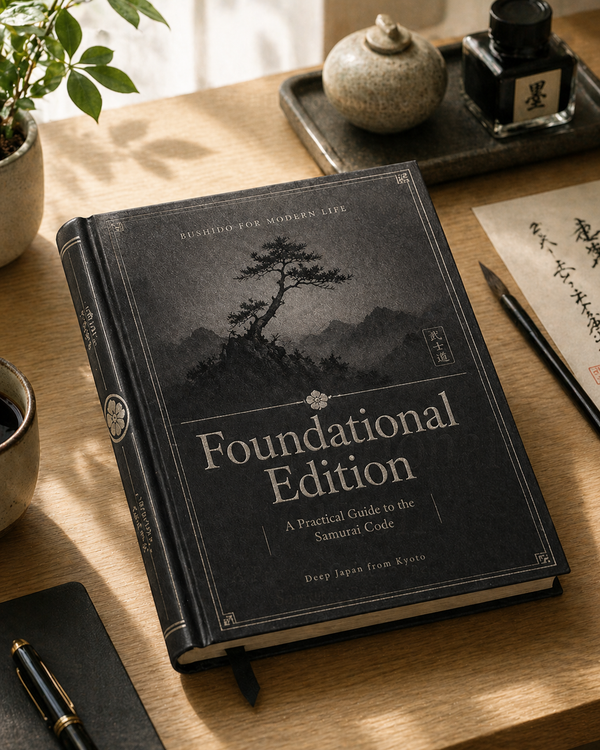
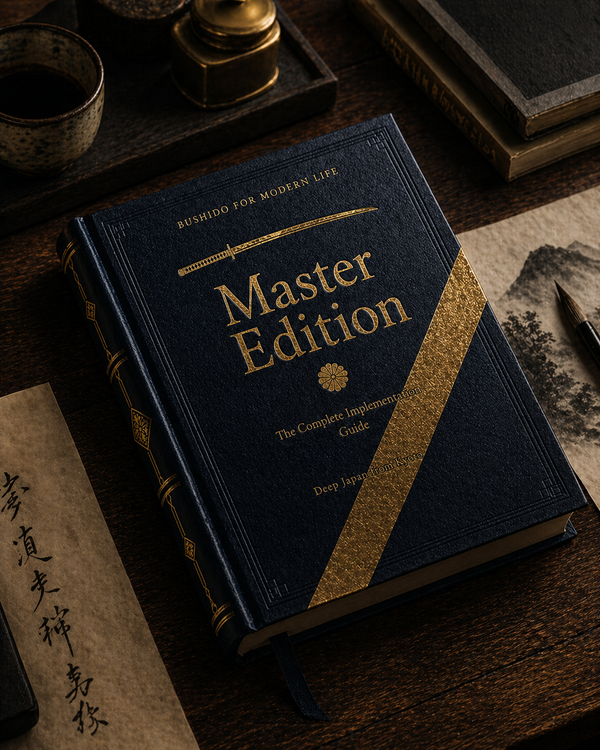
We've put together an e-book that traces the Bushido code through stories like this one — connecting the lives of Japan's most iconic samurai to timeless principles you can actually use. It reads less like a history lesson and more like a conversation across centuries.
Bushido for Modern Life(Complete Edition)| The Full Two-Book System — Framework + Implementation